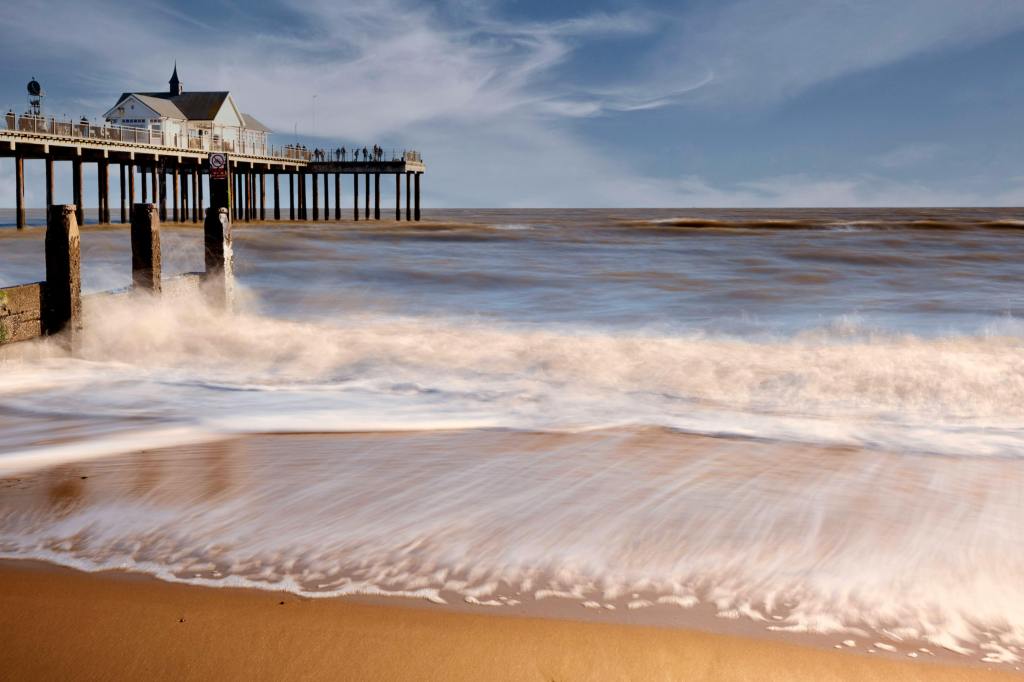
What can be said about Suffolk that you can’t read about on its Wikipedia websitepage site? Very little. But, to summarise, the county is a land-based entity; is home to many peoples; and so on. Some say it’s Britain’s oldest place; others claim it’s Britain’s youngest place. There seems no definitive way of discovering the truth. Lots of famous films, TV shows and books haven’t been set there. Why not? No one seems to know. If you contact the Suffolk Tourist Board by telephone on a weekday and begin asking questions, they more often than not hang up on you. There are many long, straight roads that can’t be explained. But enough of all that. Let’s delve into Suffolk’s rich history of the bizarre and the terribly horrible…
Jailed for armed fraud in the later 80s, Jimbet Funta was granted early release in 1993 by a kindly, thoughtless judge, and decided to become a non-recidivist. He used language as a form of communication, employing written and verbal words to broadcast his inner thoughts via the eyes and ears of watchers and listeners alike. Prison had altered the dangerous thief’s psychology: chiefly, he wanted to help others (them in the world that weren’t him) rather than act as a criminal hindrance in their lives. A keen writer, as well as a fan of women, Funta was drawn to some of the leading gentlemen’s publications of the day, including esteemed titles like Loaded, FHM and MuckySplat, for which he began to pen articles detailing his journey from violent thug to nice, friendly man. MuckySplat’s then editor, Korbolt Nudger, recalled: “That was possibly the most important era in the history of Western Civilisation. Every day – every day, mark you – I would stroll into my office and sit down for four seconds before heading back out to score copious amounts of cocaine and magnums of champagne – every day! I’m not sure if everyone in the country knew what we were doing down at that little office, but those in the know knew (or should that be, those in the knew knewed?) that there was no one else, anywhere, probably ever, doing something so important, so game-changing, so…so….so important…and game-changing.”
He continued: “This was every day! Every day. And the models! Of course, I think stuff like that is belittling towards women and I think it’s bad but it was, I think, something that had to happen, as we were, I think, game-changing the world back then, I think. Oh, and someone called ‘Jimbet Funta’ used to write the odd column for us.” And then, in 1998…
It was a standard year (1998, as mentioned above): 365 days, 52 weeks, 12 months, 24 half-months. The World Cup was held in France; Wimbledon was held in London. Jimbet Funta was running a successful clinic for the disillusioned in a Suffolk suburb. Wretched souls spooled to his compound for advice, direction, spiritual cleansing, peace and knowledge. Upon a rotating podium, Funta fumed and fulminated against the manifest evils of the day, including JSD (Jet Stream Delinquency, a theory that sugar is nefariously added to the jet stream to fatten birds and other air travellers), Big Farmer (a local peacock farmer, Dave Splogg, with whom Funta had frequently quarrelled) and Lemsip (which Funta insisted was laced with chemicals designed to shrink male genitalia).
So, anyway, one night, sometime between July and June, Funta was arrested by the sight of a peculiar mist that had materialised outside his retreat. Indeed, he later said: “I was arrested by the sight of a peculiar mist that had materialised outside my retreat.” His curiosity moved him to move towards the mercurial fog, and soon he found himself within its nebulous tendrils. What happened next was extraordinary. “I found myself,” prattled Funta to a Daily Telegraph journalist he’d cornered in a railway siding, “transported to another dimension. I saw the earth in its true form – it was formless. Our ‘real’ world is a visage. It masks the true universal substance! We are such things that aren’t really very real – not really very real at all.”
He went on: “The one and true proper reality is the one that you can’t see, but I can and have.”
Urged to prove these remarkable claims, Funta snapped “The proof’s in the pudding”, and whipped an unusual pudding from his belt. The offering soothed the journalist who quickly ate it. “Very nice,” she said. And that’s where the story would have ended, had it ended there; but it went on.
Two years and score later, Funta’s flame was faltering: the fans were drifting away, the growth of the then burgeoning internet offering many a fresh outlet for their dyspeptic ruminations and ghoulish anguishes. With funds dwindling, Funta sought new avenues for cash production. He adopted geomancy for a trimester, tossing gravel on patios in the pursuit of revelations. That failed to ignite much enthusiasm amongst the angrily puzzled, so he tried Tarot, something to do with an ironing board, second sight and horse ripping – all of which slumped. Steadily convinced that the world was against him, Funta joined the Liberal Democrats, stood in the local council elections, became Chair of the Allotments Working Group, married a fellow councillor, had two children, hurt his leg in a pedalo accident in 2003, was charged with misappropriation of council funds, culminating in a five-year sentence, and finally retired to a nice little cottage in Morecambe, where he lives to this day.
What to make of all of this? In his autobiography, Diary of a So-called Madman, determinedly straightened and ineradicable journalist Peter Hitchens pouted: “Let Funta’s story stand as a lesson to us all: the Truth, when it rears its head, often via the mechanism of great men, is universally dismissed by the congenitally ignorant, dull and unworthy. We may as well all go and live in dustbins.”
Hmm.
 Mysterious EnGland
Leave a comment